
7.3 Loading: the adapter contract, sidecars and ownership
Four entry points put data into the stores, and they differ in who asks and in what the result is filed under. This page is the contract the adapters keep, the dispatch that picks one, the search for the files that sit beside a program, and the ownership rule that decides which load may replace which.
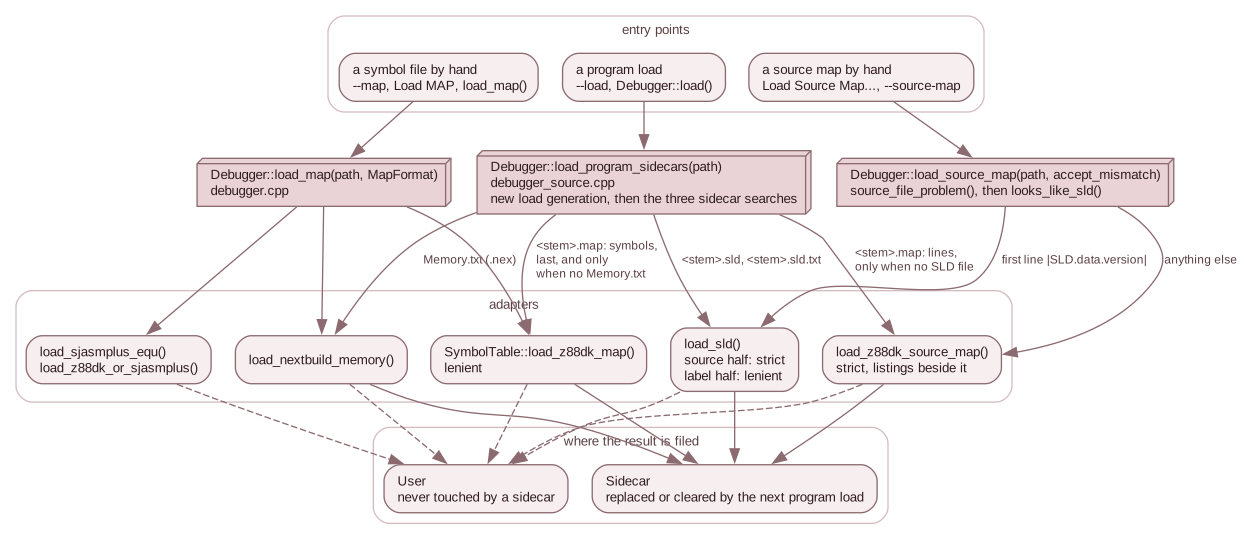
A program load searches for sidecars and files what it finds as the program's
(Sidecar). A hand load, from --source-map, Load Source Map or --map, is the
user's (User) and is never touched by a sidecar.
The adapter contract
Every adapter keeps the same promises, and a new one must too (7.8 has the checklist).
- Parse the whole input before touching a store.
load_sld()reads every line and callsmap.replace()once, at the end;load_z88dk_source_map()places every record first and callsmap.replace()last. A refusal returns before that, with the store untouched. The symbol loadersclear()their table only once the file has opened. - A source half is strict; a symbol half is lenient. A record the source
half cannot place refuses the half, with a reason that names the line
(
"line 12: ...","malformed SLD record at line N"). The symbol half skips what it cannot place and counts the rest:parse_label()insld_loader.cppreturns false for a record that names nothing, andSymbolTable::read_z88dk_map()continues past a symbol no rule places. A bad source record must not cost the user their labels, and a label that does not fit 16 bits must not cost them their lines. The C variable records are lenient like the symbols: one the decoder refuses is kept in the store'srefused()with its reason, one that cannot be joined stays unresolved with its reason, and neither refuses the lines (7.9). - One file can be two transactions. A z88dk map is read twice
(
SymbolTable::load_z88dk_map()for the symbols,load_z88dk_source_map()for the lines, which fills the C variable store in the same pass and hands it to the samemap.replace(), 7.9). An SLD is read once and yields both:load_sld(map, path, &labels). A file refused as a whole (a missing header, a bad device or identity record) loads neither half and leaves both stores as they were; a bad trace record refuses only the source half, and the labels still load (SourceMapLoadResult::labels >= 0). - A listing is dropped alone. A z88dk
.listhat does not hold up is left out with a note (SourceMapLoadResult::listing_notes), and its module keeps the map's records (7.4.4). It never refuses the map. The count reaches the frontends asSourceMapLoad::listingsand the notes asSourceMapLoad::listing_note; the sidecar log saysand N listingsand one Warn per note. - Look before opening.
source_file_problem(path)(debug/source_file.h) returns a reason, or empty. It refuses anything that is not a regular file (a FIFO or device would block or never end) and a file overSOURCE_FILE_MAX_BYTES, 64 MiB; a missing file is left to the open, which reports it.load_sld(),load_z88dk_source_map()(and the section binaries and.lisfiles it reads),load_z88dk_map(),load_simple_map()andload_nextbuild_memory()call it. The two sjasmplus-capable symbol loaders differ from the others as follows.load_z88dk_or_sjasmplus(), which serves--map, must open--map <(cmd), a pipe and so not a regular file, so it cannot ask first: it reads the file exactly once into memory, in chunks, and refuses the load when more thanSOURCE_FILE_MAX_BYTESarrive ("input is over the 67108864-byte limit", table untouched), a pipe included.load_sjasmplus_equ()(MapFormat::SjasmplusEqu, the Qt Map menu's sjasmplus load) is a path the user picked, so it does callsource_file_problem(), like the Map menu's other loaders; the menu shows the reason in its "Load Failed" box.load_z88dk_map()andload_simple_map()refuse such a file with the table untouched and say why through their optionalwhyargument; the cap refusal is rowZ88MAP-27. A file that merely fails to open returns-1withwhyleft empty (load_nextbuild_memory()alone sets "could not open Memory.txt file"), and the table is untouched there too (if (!file.is_open()) return -1;comes beforeclear()). - Emit only qualified ranges. Every
SourceRangecarries aFetchSource(7.1); the adapter decides it, andSourceMapnever invents one.
A format is supported only once its extent rule (how far a record's range extends) and its space rule (which memory a record belongs to) are written down; those are the first two parts of every 7.4 page.
Dispatch by content
Debugger::load_source_map(path, accept_identity_mismatch, verify_at_first_execution, dot_only)
(debugger_source.cpp:452) is the hand load. After source_file_problem() it tells
the format by content, never by extension: looks_like_sld() is true when the
first line starts |SLD.data.version|, or when the file cannot be opened at all,
so that the SLD loader's own error names it. Anything else is read as a z88dk
map. A UTF-8 byte-order mark (EF BB BF) at the very start of the file is skipped
first, by skip_utf8_bom() (source_file.cpp), in the router and again by
load_sld() before it requires the first line to be exactly
|SLD.data.version|1 (only a trailing CR dropped): a BOM'd SLD loads exactly as
the same file without the BOM (owner decision, 2026-11-01; rows SRCDBG-Z88-30
and -33). Only the very first three bytes count: a second BOM, or a BOM after
a leading blank line, is ordinary text, so such a file is not an SLD and goes to
the z88dk adapter, which refuses it (SRCDBG-Z88-34). Every
text loader skips it the same way: the z88dk source adapter, the --list listing
reader (whose first header names a source and carries rows, so a BOM left in
it would break the anchors and the file names), and the five symbol loaders
behind --map and Debug > Map (z88dk, sjasmplus EQU, Simple, NextBuild
Memory.txt, and the choose-by-content one, which erases one leading BOM from
the bytes it read, as a pipe cannot be rewound). Rows: SRCDBG-Z88-35,
MAPBOM-01..06, Z88LIS-44.
- An SLD goes to
load_sld(candidate, path, &labels). - A z88dk map goes to
load_z88dk_source_map(..., Z88dkListings::Beside); its symbols stay withload_map()and--map. A map whose load returnscount == 0(built without-debug, no usable listing) is refused with"no source lines in '<path>' ..."and the listing notes appended.
Before the map is filed as the user's, load_source_map() checks the program
identity (7.2): a mismatch is refused unless
accept_identity_mismatch, and for a program that is not in memory yet
(verify_at_first_execution, used for tapes) a map with an identity attaches
pending (7.6). Only then does the user's store take it. SourceMapLoad::identity_note is the suffix a
frontend appends to its report: verified, not verified for lack of section
binaries, or verified for the code the binaries cover with N ranges unchecked
(identity_note() in debugger_source.cpp).
Debugger::load_map(path, MapFormat) (debugger.cpp) is the symbol-file load.
MapFormat has five values: Z88dk, Simple (SYMBOL = $ADDR), NextBuild,
SjasmplusEqu and Z88dkOrSjasmplus. The last is the one --map uses
(ScriptHost, script_host.cpp): SymbolTable::load_z88dk_or_sjasmplus() reads
the file once into memory and lets its first line pick the loader (an
sjasmplus EQU line, whatever its value, or anything else, an empty file
included, taken as a z88dk map). It is by content because sjasmplus names its
files freely and z88dk's assembler writes a .sym of its own, in the map format.
On success the symbols become the user's and a rule-4 z88dk symbol takes the RAM
page predict_fetch says is mapped (SymbolTable::bind(), 7.4.3);
on failure (-1) the table and its owner are as they were.
--source-map
EmulatorConfig::source_map_file is set from --source-map FILE
(EmulatorConfig::source_map_file, src/main.cpp:878, :2193). EmulatorConfig::source_map_no_program (emulator_config.h:298),
set at src/main.cpp:2207, says which of three cases it is: 0 a program loads and the map
follows it; 1 there is no --load; 2 an RZX replay is the program (--rzx-play, or
--load R.rzx, told by the extension).
With a program (0). Each loop owner (headless_app.cpp, sdl_app.cpp,
gui/qt_app.cpp) calls load_program_sidecars() after its first successful --load
and then emulator_attach_cli_source_map() (platform/emulator_boot.h:112), the same call
as a hand Load Source Map with a mismatch refused. A refusal logs an error and the run exits 1.
When the program is a tape (program_loads_later()) the helper passes deferred, the map
attaches pending, and the loop owner watches it once per tick with
emulator_poll_cli_source_map() (source_map_watch_): a map dropped by the check logs
--source-map: dropped: <reason> and exits 1.
Without one (1 and 2). There is no program to judge a map by, so only the map of a z88dk
dot command is accepted. Each loop owner makes the load once, at start-up, before
ScriptHost::start(), so a file:line rule in a script resolves
(the guard is source_map_no_program: headless_app.cpp:77-91, sdl_app.cpp:252, gui/qt_app.cpp:352). The call is
emulator_attach_cli_source_map(dbg, file, deferred = false, dot_only = true, rzx = (case 2)),
which passes dot_only to load_source_map(). After the adapter has parsed the file,
dot_only && !candidate.dot() returns SourceMapLoad::not_dot with the error "it is not the map
of a z88dk dot command" (SourceMapLoad::not_dot, debugger_source.cpp:494), and the helper words it for the frontend:
--source-map requires --load FILE, or the map of a z88dk dot command: '<file>' is not one, or,
for case 2, --source-map with an RZX replay accepts only the map of a z88dk dot command (SourceMapLoad::not_dot, emulator_boot.h:120-125).
The refusal makes the start-up fail (exit 1). A dot map is deferred whatever
verify_at_first_execution says: defer = (verify_at_first_execution || candidate.dot()) &&
!verify_spans().empty() (verify_at_first_execution, debugger_source.cpp:502), so it attaches pending with the note "identity
check pending: the dot command loads when it runs", and source_map_watch_ is set from the result.
How it is then judged is 7.6; how its sections are placed is
7.4.3, rule 5.
The sidecars of a program
Debugger::load_program_sidecars(path) is called after every successful
--load in the three loop owners (headless_app.cpp, sdl_app.cpp,
gui/qt_app.cpp) and by Debugger::load() (debugger_reconstruct.cpp), which is
what a remote client's load verb runs. It looks beside the program for three
kinds of file, using the non-throwing std::filesystem calls and accepting only
a regular file (a FIFO would block the load; a broken or looping link is "no
sidecar"):
| Sidecar | Search | Applies to |
|---|---|---|
| NextBuild symbols | <stem>.Memory.txt, then Memory.txt in the program's directory (nextbuild_sidecar()) |
a .nex only |
| SLD | <stem>.sld, then <stem>.sld.txt (load_sld_sidecar()) |
any program |
| z88dk map | <stem>.map (z88dk_map_sidecar(), program_has_z88dk_map()) |
.nex, .tap, .sna |
source_file.cpp holds the one table of program formats: .nex and .sna load
at once, .tap, .tzx and .wav load later (program_loads_later(): the
machine reads them over the following frames), and only .nex, .sna and .tap
have a z88dk map.
Symbols. The user's symbols are never touched (logged as "Kept the loaded
symbols ... not loading ..."); their rule-4 symbols are re-bound to the pages
mapped now at every program load. Otherwise the program's store is assembled in
one block, in this order, first wins on every key (SymbolTable::merge()):
Memory.txt;- the SLD's
Llabels, when the SLD file is not refused as a whole, its identity does not mismatch and the user's source map is not kept (an SLD with no label is not a symbol source); - the z88dk map's symbols, last, and only when no
Memory.txtexists and its identity does not mismatch.
The log says what was attached, by log->info(): Loaded N SLD labels from '<file>' (log->info(), debugger_source.cpp:780) and
Loaded N z88dk symbols from '<file>' (log->info(), :786).
If nothing attached, a previous program's Sidecar symbols are cleared, also when
the new Memory.txt cannot be read (SidecarLoad::symbols_unreadable): a
previous program's data never survives into one it does not describe.
Sources. The user's source map is kept if there is one (logged). Otherwise a previous Sidecar map is cleared, then: the SLD's source half if an SLD file exists, even a refused one, whose refusal is reported; only if there is no SLD file at all, the z88dk map's source half. A z88dk map with neither symbols nor line records is not a map: ignored without a word. A map whose section binaries or hash do not match memory is rejected whole, its symbols included. A tape program's identity cannot be judged at the load call, so its map attaches pending.
Ownership. Each store has an owner, Impl::StoreOwner: None, Sidecar or
User, tracked explicitly because an empty-looking store can still be the
user's (a map of ; const lines only). The rules, all in debugger_source.cpp
and debugger.cpp:
- Ownership changes only on a successful load.
- A sidecar load never touches a
Userstore. A user's source map is carried into the new load generation without a second verification (the machine has not changed since the load call). - A hand SLD's labels become the user's symbols (
Impl::attach_hand_labels(),symbols_from_sld), unless the user loaded a MAP (then the count is-1, the MAP kept). A hand SLD with no labels clears only an earlier hand SLD's labels. Debugger::clear_source_map()andclear_symbols()set the owner toNone.
What was refused. SidecarLoad::problem is the one-line account of what was
found and refused: NextBuild symbols '<file>' rejected: <reason> and/or
source map '<file>' rejected: <reason>, joined by "; ", empty when nothing
was refused. The file is named, not the program. load_program_sidecars() fills
it and logs each refusal as well. The headless loop warns
--load: <problem>, the SDL loop load: <problem>, the Qt loop hands it to
DebuggerManager::report_sidecars() in a debugger build (the log and the main
window's status bar for ten seconds) and warns otherwise, and a remote Debugger::load() logs load: <problem> at Warn to
every client. The Source tab reads the reason for the source half from
source_map_status().reason, which the next load or drop replaces.
For a program that is not in memory when the load call returns, see 7.6.